From our place on Earth, the Sun and the Moon look like they are identical in size but in reality that is far from the truth. This activity will help students to become more familiar with the size and scale of the three entities involved in a solar eclipse: Sun, Moon, and Earth
Materials:
- Copies of the Sun, Earth, and Moon handout sheet
- Measuring tape
- A large room or a long hallway where you will be able to walk 65 feet in a straight line without many obstacles
- 65 feet length of string
What to Do:
1.Show participants the image of the Sun. Ask participants to guess how big the Earth and Moon would be if the Sun is the size of this image
2. Reveal the answer by showing the image of Earth and the Moon. NASA has a resource that shows the relative size of the Sun and Earth and all that would need to be made is the Moon.

3. Ask participants to guess how far the model Earth and the model Moon should be from the model Sun. It’s suggested to allow participants to walk to where they think the distance should be. The model Earth should be 65 feet away from the model Sun and the model Moon about a quarter of a mile from the model Earth. Use the cut piece of string to guide you or a pre-marked spot.
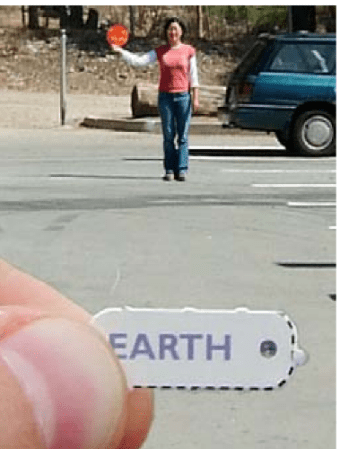
4. At 65 feet away, look back towards the model Sun and model Moon. Elaborate on how big it looks to at this distance. At this scale, the model Sun and model Moon should be about the same size as the actual Sun and Moon would appear to us here on Earth.
This activity will provide the first introduction into the factors that lead to a solar eclipse. Students need to understand how the Moon is able to cover a sun although they are different sizes and have different distances. The combination of these two allow the Moon to seemingly cover the Sun which can be further explained in the next activity. This provides a foundation for the broader concepts related to the Sun, Moon, and Earth and how it relates to the occurrence and rarity of solar eclipses.
Resource:
Click to access solar_pizza.pdf
 Solar Eclipses in the Classroom