Among the interactive activities listed on this site, it can be beneficial to supplement the key concepts of size, orbit, and their relation to solar eclipses with When the Sun Goes Dark by Andrew Fraknoi. The story line consists of grandparents who go hunting for solar eclipses and their grandchildren are trying to understand WHY they bother to do this and what solar eclipses really are. The book could be used in its entirety with the large breadth of helpful information it includes. But, it can also be used in sections to support the main ideas of a given day in the overall unit.
Size, Scale, and Distance
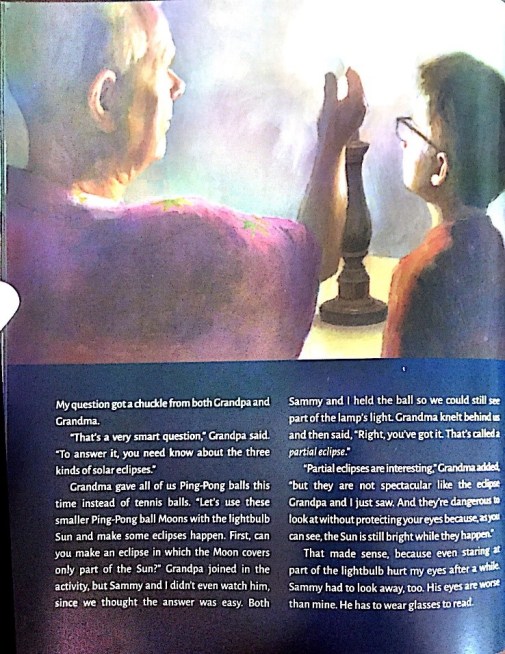
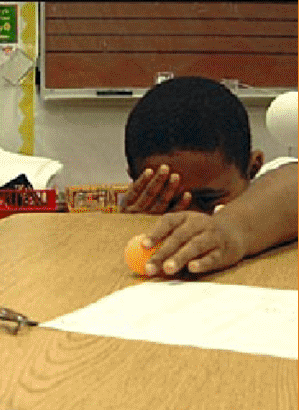
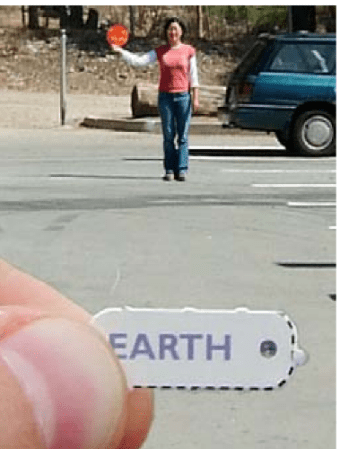
In one section of the book, an activity the child and grandparent do resembles the activities mentioned on this site. It uses a ping pong ball and a light bulb to show the difference between partial, total, and annular eclipses and how the distance and size of the ping pong ball relative to the light bulb affects the type of solar eclipse and whether it is able to occur. This section can be read while completing the similar activities to support a more concrete understanding.
Orbits
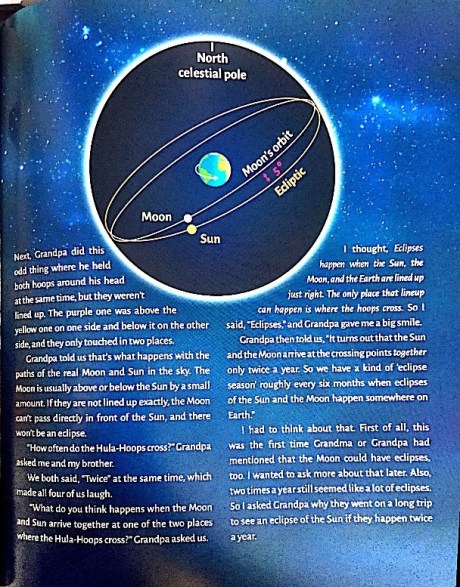
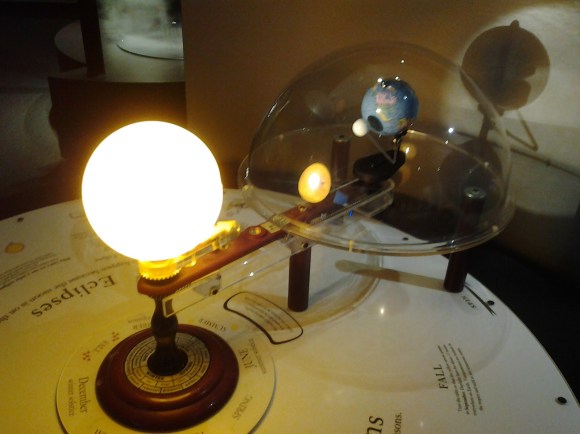
In this section, the grandparents show the grandchildren how the orbits of the Sun and Moon overlap at two points in their paths which is where eclipses can occur. This helps to address that in order for a solar eclipse to occur the Moon needs to cover the Sun but also why they are fairly rare. This is elaborated on when the story talks about the partial, total, and annular eclipses and how frequent and rare each one is and why. This can be combined with activities that emphasize the Earth, Moon, and Sun’s orbital patterns
Moving Beyond
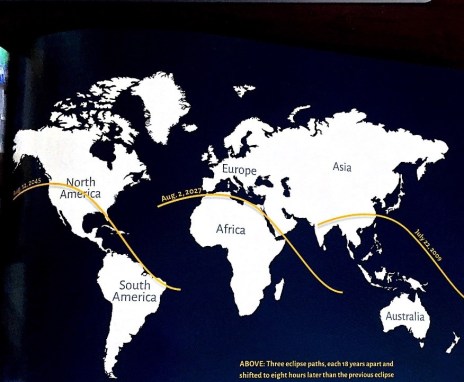
As the unit comes to a close, the book can also be useful for showing students what they can do with their newfound information. The book talks about how astronomers are able to predict future eclipses, both when and where. Students can learn HOW these scientists are able to do this and also figure out when they may be able so see a solar eclipse, partial or total.
These are just a few sources of information that When the Sun Goes Dark provides. There are more pages and more wonderful pictures that can be used to support student engagement and learning. Combined with interactive activities, the reading provides an in-depth experience that gives students a well-rounded understanding of what a solar eclipse is, what the required conditions are, and how to use the information.
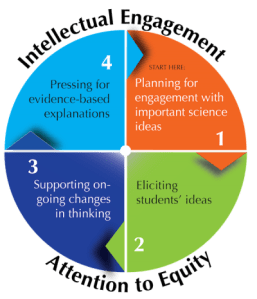 The work of a teacher can be overwhelming and with all that’s a part of implementing Ambitious Science Teaching, the workload can be even more to ensure students have an engaging and cohesive experience. For teachers looking to integrate Ambitious Science Teaching in their classroom, this site will give the some helpful pointers by providing potential activities. This blog will help provide some sample activities that can be used for space units in upper elementary. Specifically, it will include activities that will support the use of solar eclipses as a guiding phenomenon to teach important concepts like: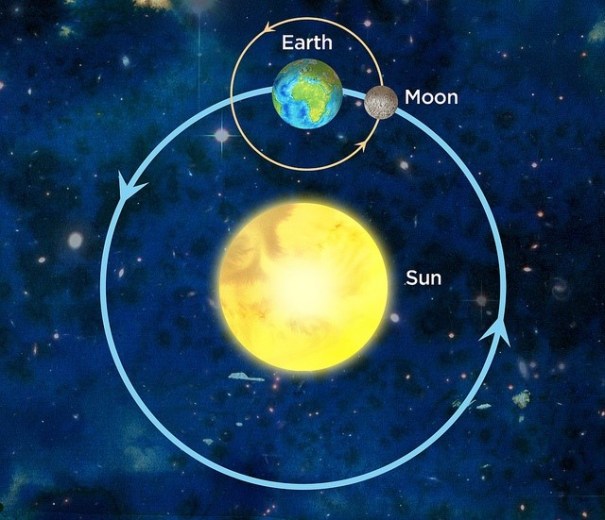


 Solar Eclipses in the Classroom