Once students have an understanding of the size of the Sun, Moon, and Earth and the distances between these three, students can see how they create the conditions for a solar eclipse, especially a total solar eclipse.
Materials:
- Ping-pong balls, one for each
participant - Two larger balls in different
sizes (e.g. a baseball and a
basketball would work well) - (optional) Image of a total
solar eclipse - (optional) Scale model of Sun,
Earth, and Moon
What to Do:
1. Ask participants to share what they know about the Sun and the Moon. How big are they? Which one is bigger? How big are they relative to Earth? Draw on students comments and observations that were made using the Size and Scale activity if it was included in the unit.
2, Hold up a large ball and hand smaller balls to the participants. These balls do not need to be to scale for the Sun and the Moon (the big difference in size makes using balls at a true scale very difficult for this activity). Challenge participants to eclipse the larger ball with their smaller ones. It sometimes helps to cover one eye.
3. Ask participants to share what they noticed. Were they able to eclipse the large ball?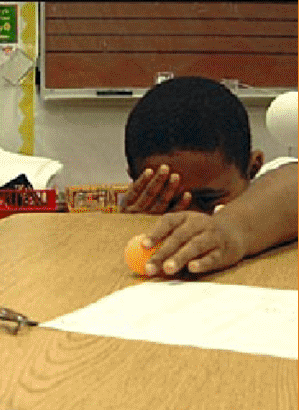
4. Now hold up an even larger ball and ask participants to eclipse this new ball. Were they able to do it this time? What did they have to do to eclipse the larger ball? They might tell you that they had to step further away from the larger ball, making it appear smaller, just enough to be eclipsed. They might also tell you that they had to bring the small balls closer to their eyes, making them appear bigger until they are big enough to eclipse the larger ball.
5. If you have a scale model, compare the size of the Sun and the Moon. Ask participants to guess how far they would need to take this model Moon before they can eclipse the model Sun.
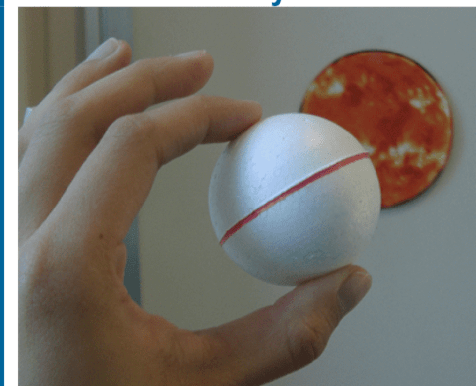
This activity serves to show students that eclipses are only able to occur under SPECIFIC conditions that are a result of the the size and distance of the Sun, Moon, and Earth. It brings clarity to how something smaller is able to cover something much, MUCH bigger. It also has another layer, showing students that solar eclipses occur when the moon covers the sun which can be elaborated on in a model representation of the phenomenon.
Resource:
 Solar Eclipses in the Classroom